The advent of 3D Printing technology has transformed dentistry, enabling dental professionals to design and produce customized solutions with unprecedented precision. From creating dental models and surgical guides to producing crowns, bridges, and orthodontic appliances, 3D Printing in dentistry is revolutionizing workflows, improving patient outcomes, and reducing treatment times. This article explores the various types of 3D printers, their applications in dental care, and the factors to consider when selecting the right printer for your practice.
What is 3D Printing in Dentistry?
3D Printing is an additive manufacturing technology that constructs three-dimensional objects layer by layer from digital designs. Unlike traditional subtractive manufacturing, which removes material to shape an object, this device builds the object from the ground up. In dentistry, this means that dental professionals can convert digital scans into accurate, tangible models, prosthetics, and custom tools, providing patients with faster, more personalized care.
How Does a 3D Printer Work?
A 3D printer reads a digital 3D model, typically in STL format, and slices it into hundreds or thousands of thin layers. The printer then deposits or cures material layer by layer according to the digital instructions. In dental applications, common materials include biocompatible resins, dental-grade plastics, and even metals. The result is a precise, patient-specific object ready for clinical or laboratory use.
Types of 3D Printers Used in Dentistry
Different types of 3D Printing technologies offer unique advantages depending on the intended dental application:
SLA (Stereolithography)
- Uses UV light to cure liquid resin layer by layer
- High precision and surface quality
- Ideal for surgical guides, splints, and occlusal guards
DLP (Digital Light Processing)
- Projects light digitally for faster curing
- Suitable for larger production while maintaining micrometer-level accuracy
MJ (Multi-Material Jetting)
- Prints multiple materials simultaneously
- Perfect for complex prosthetics and multi-material dental models
PJ (PolyJet)
- High-resolution printing with excellent surface finish
- Produces durable and color-rich dental components
SLS (Selective Laser Sintering)
- Uses a laser to fuse powdered materials
- Produces strong, large-volume parts quickly
Applications of 3D Printing in Dentistry
3D Printing in dentistry has multiple applications, including:
- Creating accurate models of teeth and jaws
- Manufacturing crowns, bridges, and implants
- Designing surgical guides for implant placement
- Producing orthodontic appliances and aligners
- Fabricating dentures and partial prosthetics
- Enhancing patient-specific treatment planning
By enabling faster turnaround and higher precision, this device improves patient satisfaction and overall treatment quality.
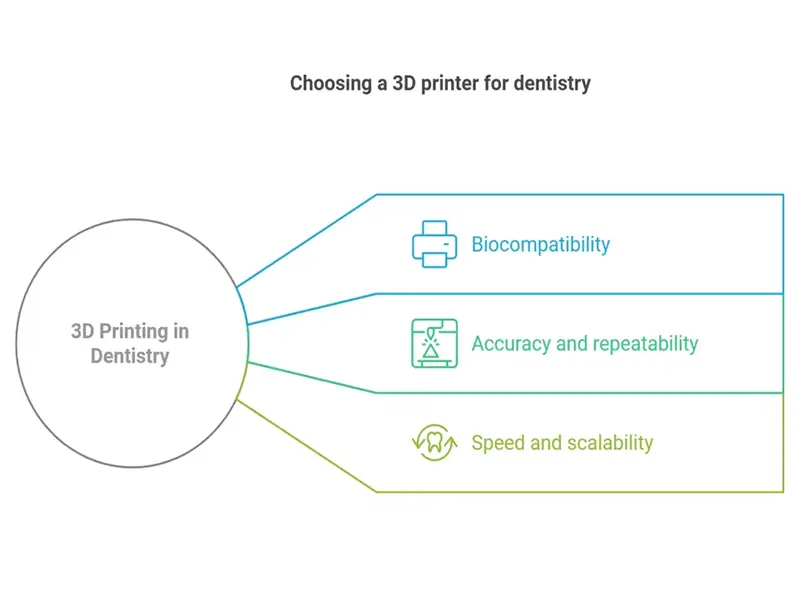
Key Considerations When Choosing a 3D Printer for Dentistry
To maximize the benefits of 3D Printing, consider the following:
- Biocompatibility: Ensure materials are FDA-approved for intraoral use
- Accuracy and repeatability: High precision ensures clinical reliability
- Speed and scalability: Faster printers enable larger production without compromising quality
- Material compatibility: Printers that support multiple resins and materials offer flexibility
- Software integration: Seamless workflow with dental CAD software (e.g., EXOCAD, 3Shape)
Advantages of 3D Printing in Dental Practices
Using 3D Printing offers numerous advantages for dental professionals:
- Customization: Tailored prosthetics and appliances for each patient
- Efficiency: Reduced chairside time and faster turnaround for dental labs
- Accuracy: Consistent high-precision results
- Innovation: Enables complex designs that are impossible with traditional methods
By integrating this device into their workflows, dental practices can deliver modern, patient-centric care while maintaining high efficiency.
The Future of 3D Printing in Dentistry
The future of 3D Printing in dentistry is promising. Advances in material science, printer technology, and software integration will continue to expand its applications. We can expect more biocompatible materials, faster production times, and enhanced automation, ultimately transforming dental treatment into a faster, safer, and more personalized experience.
Ready to Transform Your Dental Practice?
Embrace the power of 3D Printing today with high-quality dental 3D printers, materials, and accessories available at FutureMirates. Enhance your workflow, reduce treatment times, and provide your patients with precise, custom solutions. Explore our range of professional dental 3D printers and take your practice to the next level of digital dentistry.