
electrosurgery vs piezosurgery: In modern surgical practice, precision and safety define success. Among the tools driving this progress are electrosurgery and piezosurgery—two advanced techniques that have reshaped how surgeons manage both soft and hard tissues. While both improve efficiency and accuracy, they differ fundamentally in their mechanism and application. Understanding these differences is crucial for surgeons and clinicians aiming for optimal outcomes.
Understanding the Core Mechanism: Heat vs Vibration
Electrosurgery operates through high-frequency electrical current that produces controlled heat at the surgical site. This thermal energy vaporizes intracellular water, allowing the tissue to separate cleanly while simultaneously coagulating blood vessels. It is widely used in soft-tissue procedures, providing rapid cutting and effective hemostasis in fields such as general, gynecological, and cosmetic surgery – and increasingly in dental soft-tissue management.
By contrast, Piezosurgery relies on ultrasonic mechanical vibrations generated through the piezoelectric effect. These vibrations selectively act on mineralized tissues like bone or teeth, leaving surrounding soft tissues—nerves, vessels, or mucosa—completely unharmed. This property makes it ideal for oral and maxillofacial surgery, dental implantology, and ENT or orthopedic applications where precision near delicate structures is essential.
Comparative Overview: Key Technical Differences
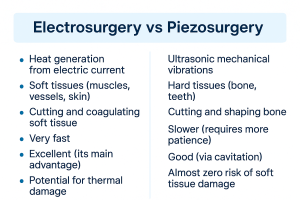
| Feature | Electrosurgery | Piezosurgery |
|---|---|---|
| Operating Principle | High-frequency electric current produces heat | Ultrasonic vibrations cut mineralized tissue |
| Target Tissue | Soft tissues (skin, mucosa, muscle, vessels) | Hard tissues (bone, teeth) |
| Primary Use | Cutting and coagulating soft tissue | Bone cutting, contouring, sinus lift, implant site preparation |
| Speed of Operation | Very fast | Slower but extremely precise |
| Bleeding Control | Excellent—instant coagulation | Good—via cavitation effect |
| Tissue Safety | Possible thermal damage if misused | No soft-tissue injury—selective action |
| Applications | General, cosmetic, dermatologic, dental soft-tissue procedures | Oral, maxillofacial, orthopedic, ENT surgeries |
| Cutting Precision | Good; heat spread depends on technique | Micrometric; high control and safety |
When to Use Electrosurgery
Electrosurgery is best suited for cases requiring speed and hemostasis in soft tissue manipulation:
-
Rapid incisions with minimal bleeding during skin or mucosal surgery
-
Excision of benign lesions or tumor removal where clear visibility is critical
-
Gingivectomy or frenectomy in dental procedures with simultaneous coagulation
-
Shortening operative time in high-throughput or emergency settings
Its main limitation is potential thermal damage to surrounding tissue if the energy output or contact time is not properly controlled. When used with precision and modern units, electrosurgery remains an indispensable tool for efficient, clean, and blood-controlled cuts.
When to Use Piezosurgery
Piezosurgery is preferred in interventions where bone precision and soft-tissue preservation are paramount:
-
Oral and maxillofacial surgery, including sinus lifts, ridge splitting, and implant site preparation
-
Orthopedic or spinal surgery requiring controlled bone removal near nerves or dura
-
Periodontal bone reshaping with minimal trauma and faster healing
While slower than rotary instruments, piezosurgery ensures unmatched control. Surgeons can safely operate near nerves or sinus membranes without risk of laceration. Moreover, the micrometric vibration pattern enhances postoperative healing and reduces swelling and pain.
Electrosurgery vs Piezosurgery: Complementary, Not Competitive
Electrosurgery and piezosurgery are often viewed as opposites, yet in practice they are complementary technologies.
-
Electrosurgery provides speed, efficiency, and bleeding control for soft tissues.
-
Piezosurgery offers selectivity, precision, and safety in hard-tissue management.
A skilled clinician integrates both—using electrosurgical precision for soft-tissue access and piezoelectric refinement for bone manipulation. Together, they represent the evolution of surgical science toward minimally invasive, patient-friendly procedures.
Final Thoughts
The choice between electrosurgery and piezosurgery ultimately depends on the tissue type, surgical objective, and the desired balance between speed and precision. Electrosurgery is ideal for rapid, controlled soft-tissue cutting, while piezosurgery excels in safe, selective bone surgery. Understanding their distinct advantages enables clinicians to deliver safer procedures, quicker recovery, and superior clinical results. Ultimately, understanding electrosurgery vs piezosurgery enables modern surgeons to choose the optimal technique for every procedure—combining efficiency, safety, and innovation.