digital workflow in dentistry: Over the past two decades, dentistry has been undergoing a digital revolution. Gone are the days of goopy impression
materials and weeks-long waits for lab work. Today, digital workflows – powered by advanced scanners, design software, and automated manufacturing – are redefining
how dentists and dental technicians work. This shift isn’t just about cool gadgets; it’s improving precision, speeding up treatments, and making the experience more comfortable
for patients. In this article, we’ll explore what the digital dental workflow is, its key components, how it compares to traditional methods, and the impact it’s having on dental care
in clinics and labs alike.
What Is the Digital Workflow in Dentistry
A digital dental workflow is a series of interconnected high-tech steps that convert a patient’s real-world dental information into a virtual model
and then into a physical restoration. In simpler terms, it’s the process of going from scan to smile using digital tools. It generally involves three main phases:
-
Digital Data Acquisition: The dentist uses an intraoral scanner to capture a precise 3D image of the patient’s teeth and gums. This replaces the traditional messy impressions. The scanner creates a digital model (often in STL or PLY file format) of the prepared tooth, neighboring teeth, bite alignment, etc., all with very high accuracy. Modern intraoral scanners can capture details to within a few tens of microns, ensuring even tiny details are recorded. In cases where an intraoral scanner isn’t used (for example, if a clinic still takes a physical impression), a desktop lab scanner can digitize a plaster model, but increasingly dentists are skipping that step and scanning directly in the mouth.
-
Computer-Aided Design (CAD): Next, the digital 3D model is imported into dental CAD software (such as Exocad, 3Shape, or others). Here, either the dentist or a lab technician virtually designs the restoration or appliance. For instance, if you need a crown, the software allows precise shaping of the crown’s contours, bite (occlusion), and fit margins on the tooth. The software can check that the designed crown will fit perfectly, with correct bite contacts and thickness. This virtual design phase is highly flexible – making a change is as easy as a few clicks, rather than remaking an impression or model. The CAD stage turns the scanned data into a detailed blueprint for the final product.
-
Computer-Aided Manufacturing (CAM): Once the design is finalized, it’s sent to automated manufacturing equipment. In dentistry, this could be a milling machine or a 3D printer (or sometimes a combination of both). For example, a crown might be milled from a solid block of ceramic or zirconia using a precise 5-axis milling unit. Alternatively, models, surgical guides, or even temporary crowns can be fabricated with a 3D printer that builds objects layer by layer from resin. These CAM technologies produce parts with micron-level accuracy, faithfully realizing the CAD design in real life. At this stage, what started as a digital scan becomes a physical, usable dental restoration or appliance.
Importantly, all these phases are digitally connected. The scanner’s data goes straight into the design software; the design file goes straight to the milling machine or printer.
Dentist and lab can share these files instantly online. This seamless digital integration means no loss of detail along the way and no need to ship models back and forth.
The result is a faster, more precise, and more reliable workflow from start to finish.

Key Components of a Digital Workflow
The digital workflow is supported by several core components and technologies, each playing a unique role in the process:
-
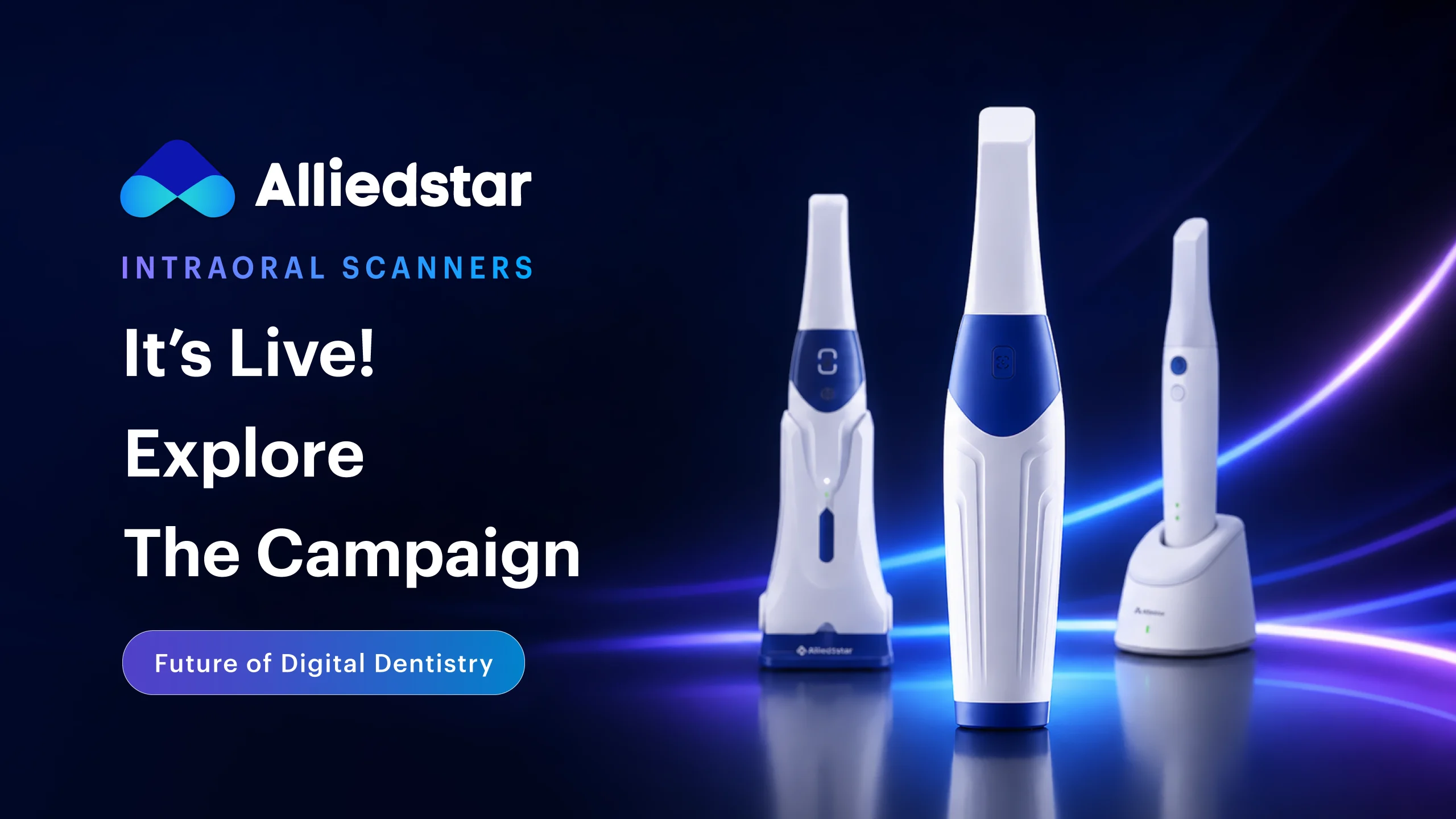
Intraoral Scanners: These are handheld devices that capture high-resolution 3D images of teeth and gums. Intraoral scanners use optical technology (often structured light or laser scanning) to create a digital impression. They can achieve accuracy on the order of 10–50 microns for single teeth or short spans, which is difficult to consistently achieve with traditional impressions. Scanning is also more patient-friendly – no more gagging on impression trays. For instance, the advanced Alliedstar AS100 intraoral scanner used in digital dentistry offers full-arch scans with ~20 µm accuracy. These devices allow dentists to get an instant model of the patient’s mouth on-screen, which can be reviewed and even 3D printed or sent to the lab within minutes.
-
CAD Software: Once the digital impression is obtained, CAD (Computer-Aided Design) software is used to design the necessary restoration or appliance. Modern dental CAD programs provide libraries of tooth shapes, tools to adjust the design, and even AI suggestions. The operator can set precise parameters like the thickness of a crown, the exact path of insertion for a bridge, or the shape of a clear aligner. The software often lets you virtually check the occlusion (how the teeth bite together) and make real-time adjustments. This stage brings dentistry into the realm of virtual simulation – you can “try in” the restoration on the computer before ever touching a piece of real material. Some CAD software now integrates with other data like CBCT scans, allowing, for example, implant surgical guides to be designed with both bone and teeth data considered.
-
Milling Machines: CAM milling units are used for subtractive manufacturing – i.e., cutting a restoration out of a solid block. They are commonly used to produce things like crowns, bridges, inlays, veneers, and even custom implant abutments from materials such as ceramic, zirconia, or titanium. High-end dental mills operate on 4 or 5 axes, which means they can cut complex shapes with excellent detail. These machines can produce a crown or bridge with very smooth surfaces and exact fit. For example, a milling machine can carve a zirconia crown that fits the tooth preparation with a marginal gap of just a few microns, improving the longevity of the restoration. Milling is fast too – a single crown can often be milled in under 15 minutes. After milling, some materials like zirconia may require sintering (baking at high temperature) for strength, which adds a bit more time, but still the entire process is typically completed the same day.
-
3D Printing: Additive manufacturing has exploded in dental applications. 3D printers create objects layer by layer from liquid resin or other materials, directed by the digital design. In dentistry, 3D printing is widely used for things like dental models (e.g., to check a crown or for orthodontic aligners), surgical guides for implant surgery, custom trays, provisional crowns/bridges, dentures, and even some permanent restorations using new resin or metal printing technologies. The advantage of 3D printing is its ability to produce very complex geometries easily – for example, a lightweight partial denture framework or an orthodontic aligner series. Printers like the Lodden D158 3D Printer are designed for dental labs to produce models, guides, and more with high speed and accuracy. There are different types of 3D printing technologies used: SLA (stereolithography) and DLP (digital light processing) are common for resin prints, while selective laser melting is used for metal frameworks. These printers can achieve layer resolutions around 50–100 microns or even finer, resulting in very detailed output. One of the exciting developments is multi-material 3D printing – some advanced printers (like Stratasys’s PolyJet systems) can jet multiple materials and colors simultaneously, which means in the near future a single printer could produce a complete denture with hard teeth and soft gum materials in one go.
-
Data Integration and Communication: A key feature of digital workflows is how well everything connects. Scans, designs, CBCT imaging, and manufacturing units all integrate via software. Many systems use open file formats (like STL) so that a scan from Scanner A can be imported into Software B and then sent to Printer C without hiccups. Moreover, clinics and labs can share files through cloud-based portals. For example, as soon as a dentist finishes scanning a patient, the 3D file can be uploaded and a lab across town (or across the world) can start designing the case immediately – no need to ship a physical model. This instant communication drastically cuts down turnaround time and the potential for errors. Some platforms even allow dentists and lab technicians to collaborate in real-time on a case, ensuring everyone is on the same page regarding the design. With digital records, everything is also saved digitally, meaning if a patient ever needs a remake of a crown years later, the original design can be pulled up from archives and reproduced exactly.
Together, these components form a powerful ecosystem. The intraoral scanner captures reality accurately, CAD software allows precise virtual planning,
CAM machines faithfully create the product, and digital communication ties it all together. The result is a workflow that is faster, more accurate,
and more adaptable than the old analog methods.
Digital vs. Traditional Methods: How Do They Compare?
You might be wondering, how much better is digital dentistry really? To answer that, let’s compare some key aspects of the digital workflow with traditional methods (the conventional process of physical impressions and manual fabrication):
-
Impression Technique: Traditional dentistry relies on physical impressions taken with materials like silicone or alginate. This involves filling a tray with gooey material and pressing it over the teeth until it sets, then sending that impression to a lab to pour a stone model. Digital dentistry eliminates this step by using optical scans. The scanner simply takes images of the teeth to create a digital model. The digital method is cleaner and saves time (no need to disinfect and ship impressions). Critically, it avoids distortions – traditional impressions can slightly shrink or get pulled/distorted when removed, whereas digital scans capture the form as-is.
-
Accuracy: One of the most important differences is precision. Digital workflows are extremely accurate and reproducible. In fact, studies have found that the marginal error of restorations made with digital impressions can be as low as about 10–30 microns, whereas those made with conventional impressions tend to have errors on the order of 50–100 microns. In practical terms, a crown made from a digital scan can fit more snugly, with fewer gaps, than one made from a rubber impression. Better fit means better long-term outcomes (less chance of bacteria leakage and secondary decay). In one clinical study, digital impressions yielded significantly lower discrepancies in marginal fit compared to traditional methods. In short, digital = finer detail.
-
Speed and Turnaround Time: Traditional workflows are slower at almost every step. Taking a physical impression might take 5-10 minutes of chair time (plus potential retakes if something went wrong), then it often needs to be mailed to a lab, which could take a day or more. The lab then needs to pour a model, wait for it to set, then manually fabricate the restoration (which itself could take days depending on the type of prosthesis and the lab’s workload). It’s not uncommon for a crown or denture to return in one to two weeks in a traditional process. Digital workflows compress this dramatically. Scanning a patient’s mouth can be done in 2-5 minutes for a full arch. The digital file transfer to the lab is instantaneous (no shipping). CAD design might take an hour or two, and CAM production perhaps another hour or so. Potentially, a single crown case can be completed in a day or even a single appointment (often called “same-day dentistry” when an in-office mill is used). Even for more complex cases handled by an outside lab, many digital cases are turned around in 24–48 hours. For example, a typical single-tooth restoration that could take a week or more with conventional methods can often be finished within one or two days using a fully digital process. This faster turnaround is a game-changer for patient satisfaction and clinic efficiency.
-
Ease of Adjustments and Redos: If something’s not right with a traditional impression (say a bubble in the impression or a model defect), the patient usually has to come back for a new impression, delaying everything. With a digital scan, if a small area is missed or distorted, the dentist can often just rescan that section immediately and patch it in without restarting the whole process. If a design needs changing, you simply modify the digital file and resend to the mill/printer – no need to take a new impression unless the tooth prep itself changed. Everything is more flexible and fixable with digital. Also, digital files serve as a permanent record. If a crown ever needed remake, you have the data to reproduce it exactly as before without a new impression.
-
Clinic-Lab Communication: In the old model, communication involved phone calls, written lab slips, and sending physical items back and forth. A lot could get lost in translation. With digital, the dentist can annotate the 3D scans, send photos, or even have an online design session with the technician. The data (not just descriptions) is the source of truth – the lab literally sees the patient’s mouth as scanned and the dentist’s desired margins, etc. This real-time digital file exchange makes the dentist-technician collaboration much tighter. It reduces misunderstandings and remakes. A file can be shared and discussed via screen share or cloud portal instantly, which is far superior to trying to describe an issue over the phone with a model in hand.
-
Patient Comfort: From the patient’s perspective, this might be the biggest win. Traditional impressions can be unpleasant – cold, gooey material pressing against the teeth and palate, often triggering gag reflexes or causing anxiety. It also usually takes a few minutes of holding a tray in the mouth, which some patients hate. Digital scanning, by contrast, is much more comfortable. A small wand is moved around the mouth, and patients usually find it easy – no mess, no bad taste. In fact, surveys have shown that most patients strongly prefer digital impressions. One study noted that around 75% of patients favored digital scanning over conventional impressions for comfort and convenience. Another report highlighted that gag reflex issues, which can occur in ~25% of traditional impressions, drop to under 5% with digital scanning. For patients who have a strong gag reflex or are phobic about impressions, digital is a lifesaver. Plus, seeing the 3D model of their own teeth on a screen can be a cool educational moment that increases patient engagement in the process.
-
Quality Consistency and Redos: With manual processes, there is variability – one technician’s work might differ from another’s; material inconsistencies can occur when mixing, etc. Digital workflows bring a new level of consistency. If the scan is good and the design is done correctly, the output from a mill or printer will be the same every single time for that file. This consistency has led to far fewer remakes and adjustments. For example, clinics that switched to digital report that remake rates (cases that have to be redone due to fit issues) dropped from around 7-10% down to under 3% after adopting digital impressions. Fewer remakes mean less wasted time and material, and happier patients who don’t have to come back because “the crown didn’t fit”.
In virtually every category – accuracy, speed, comfort, communication, predictability – digital workflows show clear advantages over conventional methods.
That’s not to say traditional methods don’t work (dentistry functioned for decades using them), but digital is raising the bar for what’s achievable.
The only areas where conventional might still be on par or preferred are unique situations (like a very long-span full-arch implant case where some argue a physical
impression might still be slightly more accurate due to current scanner limitations, or if a clinic can’t afford the tech yet). But as scanners and software improve,
those gaps are closing fast. For everyday dentistry, the digital approach has proven superior in efficiency and often in outcome quality.

Applications of Digital Workflows in Dentistry
Digital workflows are being applied across almost every specialty of dentistry. Here are some of the major areas where digital techniques are making a big impact:
In Clinical Dentistry
-
Restorative Dentistry (Crowns, Bridges, Veneers): This is one of the most common uses. Dentists use intraoral scanners to take digital impressions for things like crowns, bridges, inlays/onlays, and veneers. The scans are sent to a mill or 3D printer to fabricate the restoration. Some dental offices have chairside CAD/CAM systems (like CEREC or others) that let them scan, design, and mill a ceramic crown right in the office, so the patient can get a permanent crown in a single visit. Even without in-office milling, a dentist can scan a crown prep and send the file to a dental lab, where technicians will design and mill the crown, often getting it back to the clinic within a day or two. For veneers or cosmetic cases, digital smile design software can even simulate the final look and create design prototypes that can be 3D printed for try-in.
-
Implant Dentistry (Implantology): Digital workflows have revolutionized implant planning and placement. A key tool here is the digital surgical guide. Here’s how it works: the patient gets a CBCT scan (3D X-ray) of their jaw, and an intraoral scan of their teeth/gums. Software merges these two sets of data to create a comprehensive digital model of the patient’s anatomy. The dentist (or specialist) can then plan exactly where an implant should go, on the computer, choosing the precise angle and depth that avoids vital structures and ensures the implant emerges in the ideal spot for the future crown. Once the virtual plan is set, a surgical guide is designed – basically a 3D printed template that fits over the patient’s teeth during surgery with sleeves that guide the drill to the correct location and angle. This results in extremely accurate implant placement with minimal guesswork during surgery. The digital workflow also extends to designing the implant abutment and crown so that once the implant is placed, the final restoration can be made to fit perfectly. Overall, implants placed with digitally guided surgery tend to have higher accuracy and success rates, and the surgery can be quicker and less invasive (flapless in many cases) because of the precise planning. For patients, this can mean a more comfortable procedure and faster healing. From the lab side, technicians also use digital scans to create custom implant abutments and screw-retained crowns that fit the implant positions exactly.
-
Prosthodontics (Dentures and Removable Prosthetics): Traditionally, making a full denture required multiple messy impressions and try-in sessions. Now, digital denture workflows are emerging. Dentists can use scanners or special impression scanning techniques to capture edentulous arches, then design dentures digitally. Denture bases and teeth can be either milled from pucks of material or 3D printed. While denture fabrication is a bit behind crowns in terms of digital adoption, it’s catching up quickly. Some systems allow for scanning existing dentures as reference or using facial scanning to help arrange teeth digitally. The result is fewer appointments and the ability to very accurately reproduce a denture or make a spare copy (since everything is saved in the software). Partial dentures (removable metal frameworks) are also now designed using CAD and either milled or 3D printed in cobalt-chrome, leading to superb fits.
-
Orthodontics: If you’ve heard of Invisalign or clear aligners, that’s digital dentistry at work. Digital orthodontics uses intraoral scans to create 3D models of a patient’s teeth, and then specialized software designs a series of gradual tooth movements. Each step is 3D printed as a model and a clear plastic aligner is made to fit it. A patient might never need a single traditional impression or physical model for their entire orthodontic treatment – it can all be done from scans. Even for traditional braces, many orthodontists now scan teeth to make appliances or retainers rather than taking impressions. The accuracy and ease of digital models also allow the use of advanced treatment planning tools, and patients can see a digital simulation of their tooth movements and expected results. Orthodontic labs also benefit – they can store models digitally rather than on shelves, and reproduce them anytime. Another area is digital smile design and cosmetic ortho, where the projected outcomes are designed and shown to patients beforehand.
-
Oral Surgery and Guides: Beyond implant guides, digital workflows help in other surgical areas. For example, if a patient needs corrective jaw surgery, the surgeon can use digital models and CBCT to plan the surgery and even print cutting guides or provisional prostheses. For extracting teeth, particularly wisdom teeth near nerves, surgeons may plan using digital imaging to avoid complications. Custom surgical guides for procedures like bone grafting or even numbness-blocking stents for local anesthesia are being developed with 3D printing.
-
Surgical Templates and Stents: Not only for implants, but templates for guided biopsies, endodontic access guides (finding canals in root canal treatment), and even guides to drill osteotomies for zygomatic implants or other complex cases are all facilitated by digital design and 3D printing.
Essentially, any time you need something custom-fit to a patient – whether it’s a crown, an aligner, a mouthguard, or a surgical tool – digital workflow
can usually do it faster and with excellent fit.
In Dental Laboratories
Digital workflows have perhaps equally transformed the dental lab industry behind the scenes. Dental laboratories traditionally had skilled artisans who
would craft restorations in wax and metal by hand. Now, much of that artisan skill is augmented (or replaced) by digital tools:
-
CAD/CAM Production: Labs have embraced CAD/CAM to handle the bulk of crown and bridge production. A typical lab today receives digital scans from dentists (or they digitize incoming impressions using a desktop scanner), then the technician designs the restoration on screen. Instead of casting metal or pressing ceramic by hand, they send the design to a milling machine or 3D printer. This results in extremely consistent fits. A lab technician’s role has shifted more toward being a designer and finisher – they spend time ensuring the digital design is perfect and then staining or characterizing the milled restoration for aesthetics. The heavy lifting of fabrication is done by machines, which can work overnight and produce multiple units with the same quality every time.
-
Laboratory Scanners: For those dentists still using traditional impressions, labs use desktop scanners to convert plaster models into digital models. High-precision lab scanners can capture details of models, including implant analog positions, with great accuracy. This allows labs to still use digital design and manufacturing even if the clinic isn’t fully digital yet. The integration of lab scanners means even the conventional inputs can be brought into the modern workflow.
-
3D Printed Models and Custom Parts: Labs now routinely use 3D printers to create dental models from digital scans, especially for clear aligner workflows, diagnostic setups, or cases where a physical model is needed for vacuum forming appliances. They also print custom try-in prostheses, denture bases, and more. This has reduced the need to maintain large physical model storage – everything can be reprinted from files as needed. It also saves material costs and time (no need to pour plaster).
-
Precision and Consistency: From a lab perspective, one of the biggest benefits of digital is consistency in output. If the design is done correctly, a milling machine will produce 100 crowns that all fit the way they should, whereas 100 crowns made by hand might have a few outliers. This consistency improves the lab’s efficiency and reputation. It also allows scaling up production – one technician can oversee multiple machines and produce far more restorations in a day than if they were all fabricated by hand. This is crucial as labs try to keep up with demands and compensate for skilled technician shortages in some regions.
-
Complex Cases and Advanced Solutions: Digital tools allow labs to tackle very complex cases with more confidence. For example, designing a full-mouth reconstruction digitally means you can simulate the occlusion and aesthetics and adjust virtually before milling anything. This reduces the trial-and-error that used to happen. For implant bars or full-arch implant prosthetics, CAD/CAM production yields incredibly precise fits on multi-unit implant cases, where manual fabrication might risk misfits due to slight distortions in materials. Labs can also collaborate digitally with dentists on these big cases – sharing designs for approval or input before making them.
-
Reduced Waste: Traditional lab work involved a lot of materials (wax, metal, plaster) that could end up wasted. Digital fabrication tends to be more material-efficient. Milling has some waste (the leftover cut material), but it’s calculated and often recyclable (e.g., milling zirconia or titanium yields dust or shavings that can sometimes be reused in certain ways). 3D printing uses only the amount of resin needed for the object (plus some support structures), and many resins allow reuse of the excess liquid. And since digital planning is precise, there are fewer remakes and adjustments, meaning less waste from having to redo cases.
-
Faster Turnaround and Capacity: With digital processes, labs can dramatically cut down production time per case and handle more cases in parallel. For instance, a lab might mill a crown in 15 minutes and have it sintering overnight, while at the same time designing the next cases. They can print dozens of models or aligners in one batch overnight. This means labs can often return cases faster to clinics, enabling dentists to deliver quicker to patients. Efficiency gains in labs directly translate to better service for dentists and potentially more business for the lab.
In summary, digital workflows have enabled labs to produce restorations and appliances with consistent high quality and shorter lead times.
It has transformed the lab from a craft shop into a high-tech production center. Many labs market their digital capabilities as a selling point – for example,
advertising that they use the latest CAD/CAM and can thus provide more precise fits and faster delivery. Dentists, in turn, choose such labs for those advantages.
The clinic and lab together form a digitally connected team, which ultimately benefits the patient through better, faster care.
Benefits of Digitalization for Treatment Quality and Patient Satisfaction
Integrating digital workflows in dentistry isn’t just about doing things faster – it’s also about doing them better.
Research and clinical experience have demonstrated several key benefits of going digital, in terms of treatment quality and patient outcomes:
-
Superior Fit and Accuracy: As noted earlier, digital processes produce restorations with extremely high precision. Better marginal and internal fit of crowns, inlays, and other prosthetics means they seat properly with minimal adjustments. This has real health implications: a well-fitting crown is less likely to trap plaque or allow leakage that can cause decay or gum issues at the margins. It also means greater longevity for the restoration. In a comparative study, crowns made from digital workflows showed significantly smaller discrepancies (on the order of tens of microns difference) in margin fit and internal adaptation compared to those made from traditional impressions. Dentists often report that crowns from digital scans “drop in” with minimal chairside grinding. Even for multi-unit cases, digital precision ensures consistent contacts and occlusion as designed, reducing the time needed to adjust in the mouth. All of this improves the quality of care, as patients get restorations that function well and feel comfortable right away.
-
Reduced Errors and Remakes: By eliminating many manual steps, digital workflows remove a lot of the typical error sources. There’s no risk of a distorted impression or a pour-up with bubbles that might ruin a model. Digital files don’t change shape or dimension, whereas physical materials can. The consistency of CAD/CAM means if a case fits on the screen, it’s likely to fit in the mouth. Consequently, the incidence of cases that need to be redone due to poor fit has dropped significantly for digital users. As mentioned, some clinics saw remake rates fall from nearly one in ten cases to only a few in a hundred after switching to digital. Fewer remakes mean the patient doesn’t have to endure another appointment or temporary, and the practice saves cost and time. It’s a win-win for both patient and provider.
-
Time Savings and Efficiency: Time is valuable for all parties involved. Digital workflows shorten clinic chairside time for several procedures. For example, a digital scan for a crown might take 5 minutes vs. a 10-minute physical impression plus the possibility of retakes. Also, digital tools often allow simultaneous steps – while a crown is milling, the dentist can attend to another patient or another task. In the lab, as discussed, production is faster and multiple cases can overlap in progress. Overall treatment time (from start to finish of a case) can be dramatically shorter. Same-day dentistry is one direct patient-facing benefit – a patient can come in with a broken tooth and leave a couple hours later with a permanent crown, thanks to in-house scanning and milling. Even when not same-day, the whole process is more efficient, meaning patients get their final results sooner (fewer weeks wearing temporaries or waiting in discomfort). This speed also means if adjustments are needed, they can happen quicker. For instance, if a 3D-printed denture try-in isn’t perfect, adjustments can be made digitally and a new one printed by the next day, rather than waiting a week for another wax try-in.
-
Improved Patient Experience and Satisfaction: Patients notice when their treatment is smoother. The comfort of digital impressions is a big plus – especially for those with sensitive gag reflexes or anxiety. Not having to take multiple impressions or have things tried in and out repeatedly makes the experience more pleasant. Also, digital workflows often engage the patient more. Many dentists will turn the screen and show the patient their 3D scan, discussing treatment needs or demonstrating what the crown will look like. This visual education can increase patient understanding and acceptance of treatment recommendations. It also just adds a “wow” factor – patients perceive the practice as modern and high-tech, which can enhance their confidence in the care. Surveys have found higher satisfaction rates among patients who have experienced digital procedures, often due to comfort and reduced visits And when restorations fit right the first time, patients are delighted that they don’t have to come back for adjustments or deal with something feeling “off” in their mouth.
-
Consistency and Predictability: For practitioners, one of the subtle but huge benefits is the predictability digital methods bring. When you take an optical scan, you can immediately see if you captured everything needed – if not, you scan that spot again. This contrasts with a traditional impression where you might not know if you got a perfect imprint until days later when the lab calls or returns a model. Similarly, with CAD design, you can adjust and check every detail on screen. By the time you send it to production, you’re quite confident what will come out. This reduces the uncertainty and stress that can accompany complex cases. From single units to full-mouth rehabs, digital tools allow a lot of planning and checking in advance, so the actual delivery of the case is more routine. For labs and clinicians, this predictability means they can plan schedules better and trust in the outcomes.
-
Integration with Digital Records and Repeatability: Once a case is digital, it’s stored in that format. Suppose a patient loses a night guard you made for them – if it was designed and made via digital means, you usually can reprint or mill a new one without another appointment, because the original design file can be pulled up. Similarly, if a crown made digitally ever needs to be remade (perhaps due to a fracture years later), you have the exact design and can reproduce it, or tweak it as needed (for instance if some tooth shifting occurred). This archival of digital records means dentistry can move toward truly personalized healthcare where data from past treatments is easily reused for future needs. It also helps in tracking and quality control – you can measure outcomes by comparing designed vs. actual fits, etc., feeding back into improved techniques.
-
Reduced Material Waste and Environmentally Friendly: Digital workflows can be more environmentally friendly. Traditional impressions and models involve a lot of plastic trays, impression material (some of which ends up in biohazard waste), plaster (which is heavy and not reusable once cast), shipping materials for sending cases, etc. By digitizing, much of that is eliminated. There are no physical impressions to disinfect and throw away; fewer shipments since files go electronically; models are only printed if needed (and can often be recycled or are made of biodegradable resin). Many dental materials have packaging and mixing waste that digital processes avoid. It’s a greener approach to dentistry in several respects.
-
Collaboration and Multidisciplinary Care: With digital data, it’s easier for different specialists to collaborate on a case. For example, an orthodontist and a surgeon can share digital models and plan an orthognathic surgery together, or a prosthodontist can get an intraoral scan from a general dentist and then consult with a lab and a periodontist by all looking at the same 3D data set for an implant case. This ability to share and communicate visual data improves the quality of treatment planning, leading to better outcomes in complex cases.
All these benefits contribute to the overarching goals of dentistry: to provide high-quality, long-lasting restorations and treatments,
and to ensure the patient’s experience is positive. Digital workflows are proving to be a key enabler of those goals, making it easier to deliver top-notch dentistry consistently.
Patients leave with well-fitting restorations done in less time and often report that the process was much easier than they expected – and a happy patient is the ultimate measure of success.

Future Trends: Where Is Digital Dentistry Heading?
Digital dentistry is evolving at a rapid pace. What we see in clinics and labs today was almost unimaginable a generation ago, and the innovation hasn’t slowed down.
Looking toward the future, several trends and emerging technologies are poised to take digital workflows to the next level:
-
Artificial Intelligence (AI) and Automation: AI is set to play a big role in dental workflows. We’re already seeing early signs of this. For instance, 3Shape (a leading dental tech company) has introduced AI-driven design services where their platform called “Automate” can design crowns or other restorations using algorithms – in fact, it can deliver a crown design in as little as 90 seconds without human intervention3shape.com. This kind of AI design can handle routine cases, allowing lab technicians to focus on more complex, custom work. In the future, we might have AI that can analyze a patient’s scans and suggest an optimal treatment plan, identify where a crown margin should be or even point out cavities or cracks that need attention (some diagnostic AIs already exist for radiographs, for example). Machine learning could improve prep design by analyzing thousands of cases and predicting what kind of prep leads to best outcomes, giving dentists feedback. We might also see AI in intraoral scanners to instantly correct small mistakes in scans or to distinguish between tooth structure and soft tissue automatically (some scanners already use AI to remove artifacts like the tongue or cheek from the scan data). Automated treatment planning in orthodontics and implantology is also likely to become even more advanced, making the planning phase quicker and potentially more precise by leveraging large datasets of successful cases.
-
Smarter CAD/CAM Software: The software we use for designing and manufacturing will become more powerful and easier to use. Expect more user-friendly interfaces and wizards that guide practitioners who are not as experienced. For example, a future CAD program might automatically set an ideal insertion path for a bridge, block out undercuts, or adjust the occlusion based on typical biting patterns – all automatically suggested, with the user just approving or fine-tuning. Also, cloud-based CAD software could allow real-time co-design sessions, where a dentist and lab technician (or two specialists) work on a case together remotely, seeing each other’s changes live. This kind of collaborative design could greatly improve complex rehabilitation planning.
-
Integration of Data (Big Data in Dentistry): In the future, a patient’s digital dental records might include not just intraoral scans, but also 3D facial scans, speech data, chewing patterns, etc. All this could be integrated to design restorations that are truly biomimetic. For example, using AI and large datasets, a software might analyze a patient’s remaining teeth and automatically generate a crown for a missing tooth that matches the patient’s unique anatomy and even shade, without the technician having to choose from standard tooth libraries. Virtual patients or digital twins could exist where the patient’s entire oral system is modeled on a computer for comprehensive simulation of treatments.
-
Advanced 3D Printing (Multi-Material & Bioprinting): Today’s dental 3D printers mostly print one material at a time (like one type of resin). But multi-material printing is on the horizon. Printers like Stratasys’s PolyJet can already print in multiple materials and colors in industrial settings; applied to dentistry, this means we could print a restoration that has, say, a hard enamel-like outer layer and a softer dentin-like inner layer in one build, making the prosthetic behave more like a natural tooth. It also means printing gingiva-colored parts and tooth-colored parts together – imagine a denture or implant bridge that comes out of the printer fully finished with lifelike gums and teeth attached. Companies are working on these multi-material dental printers, and as materials science advances, the printed parts will also improve in strength and wear resistance. Bioprinting is another futuristic concept: researchers are exploring printing with actual cellular materials to perhaps one day create real tooth structures or tooth scaffolds that could integrate with the body. While that’s likely further off, it underscores the trajectory of technology.
-
Chairside Everything: We already have chairside crowns. We may soon see more chairside 3D printing in everyday use – for example, a dentist might print a custom night guard or a temporary denture right in the office within an hour. As printers become smaller, faster, and cheaper, they could become a standard fixture in dental operatories just like autoclaves or X-ray units. This means even fewer appointments and more one-stop solutions for patients. Chairside printing combined with AI design could mean a patient with a chipped tooth could have a custom veneer designed and printed while they wait.
-
Digital Workflow for All Specialties: Areas like endodontics (root canal therapy) and periodontics (gum treatments) are also finding digital angles. There are already virtual endodontic guides that can direct a drill to the precise location of a calcified canal. In perio and oral surgery, digital planning for grafts or sinus lifts might become standard. Laser-sintered bone graft replacements or custom 3D-printed membranes for guided tissue regeneration could be coming, all based on digital impressions of bone defects.
-
Augmented Reality (AR) and Digital Guidance: Future dentists might wear AR glasses that project the digital plan onto the patient as they work. For example, the glasses could display a virtual outline of where a preparation should be or where an implant is planned, guiding the dentist’s hand to match the digital design. This would merge the digital and physical realms in real-time. A few experimental systems already try to do this with projectors or special glasses, and it will likely improve. It’s another way to bring the precision of the digital plan directly into the procedure.
-
Cloud and Remote Dentistry: The concept of cloud dentistry means everything – patient scans, designs, x-rays – is stored securely online. This makes it easy for multiple providers to access records anywhere. It also enables teledentistry consultations where a dentist can remotely assess a scan or design. In the lab context, a designer in one country could do the design work overnight for a dentist in another country, essentially a “follow the sun” model to speed up service. We may even see more use of central AI or design farms – where thousands of cases are processed via cloud AI overnight and ready by morning for local 3D printing.
-
Personalization and Predictive Analytics: As digital records accumulate for patients, we might use that data to predict outcomes. For example, if a certain type of crown design tends to fail after 10 years in some patients, AI might catch patterns related to bite force or alignment that predict that, and warn the dentist to adjust the design for longevity for that patient. Dentistry could become more personalized, tailoring materials and designs to individual patient habits (grinding, diet, etc.), much of which could be inferred from digital data over time.
All these developments point toward a future where digital workflows become the norm and are even more powerful. It’s reasonable to predict that in a decade or so, dental offices that are not using digital techniques will be extremely rare, much like offices without computers or digital X-rays today. The combination of digital precision with emerging technologies like AI will likely yield treatment results that are highly predictable, efficient, and customized to each patient. The ultimate goal is a scenario where we can virtually ensure the outcome before ever touching the patient – truly “measure twice, cut once,” but in dentistry terms, it’s “scan/design twice (or as much as needed), treat once.”
For practitioners, keeping up with these trends will be important, as they promise not only improved care for patients but also streamlined workflows that make the dentist’s and technician’s jobs easier and more enjoyable (fewer tedious tasks, more focus on the art and science of designing smiles). For patients, the continued digital transformation means better experiences and better results – a future where dental treatment is quicker, gentler, and produces restorations that feel just like natural teeth.
Conclusion
The adoption of a digital workflow in dentistry represents a transformative milestone for the profession.
By integrating technologies like intraoral scanning, CAD/CAM design, and 3D printing, dentists and dental labs
can deliver a level of precision and efficiency that was simply not possible with traditional methods.
The evidence is clear: digital methods can produce restorations with smaller marginal gaps, more accurate occlusion, and far fewer errors.
Patients benefit through more comfortable procedures (no more gag-inducing impressions), faster turnarounds, and outcomes that often fit right on the first try.
From the clinical perspective, digital workflows turn what used to be a craft mixed with some guesswork into a data-driven science.
Dentists can now plan and execute treatments virtually before doing them physically, reducing surprises and improving success rates.
From the laboratory perspective, the digital revolution has turned labs into high-tech production centers capable of consistent,
high-quality output, while also fostering closer collaboration with clinicians via shared digital data.
Of course, transitioning to a digital workflow does come with challenges. It requires investment in equipment and training.
There can be a learning curve for dentists and technicians to become proficient with scanning and designing. Additionally,
ensuring compatibility and integration between different systems (scanner, software, mill/printer) is important for a smooth process.
However, as many early adopters will attest, the benefits far outweigh the initial costs.
Many practices see increased productivity and patient volume thanks to digital tech (patients drawn to modern offices,
or time saved allowing more appointments per day). Labs often find that digital capabilities attract more business from dentists seeking those services.
In essence, digital dentistry is bridging the gap between the dentist’s chair and the lab bench, making it almost as if the technician is in the operatory and the dentist is in the lab
because they share the same digital information in real time. This synergy leads to a more unified team approach to patient care.
As we look ahead, it’s evident that digital workflows are not a passing trend but the new standard of care.
The continued advancements in technology – AI, better materials, faster machines – will only further cement digital methods as the backbone of dental practice.
We are moving toward a dental ecosystem that emphasizes precision, personalization, and predictability at every step.
Ultimately, embracing the digital workflow is about elevating the quality of dentistry: doing it faster, doing it better, and delivering a superior experience to every patient.
In the coming years, we can expect digital dentistry to become virtually synonymous with modern dentistry, and those who adopt it will be at the forefront of delivering
future-ready, high-quality dental care.
Ready to embrace the future of dentistry? At Futuremirates, we specialize in empowering clinics and labs with state-of-the-art digital dentistry equipment and solutions.
From cutting-edge intraoral scanners to high-precision 3D printers, we have everything to kickstart your digital workflow journey.
Feel free to explore our range of digital dentistry products and contact us for guidance on integrating these technologies into your practice.