Introduction
Prosthodontics, the specialized branch of dentistry focused on the rehabilitation and restoration of missing teeth, has undergone a remarkable evolution. The rise of digital dentistry has transformed conventional workflows by integrating CAD/CAM technology, intraoral scanners, and 3D printing into daily clinical practice. This article provides a comprehensive and evidence-based comparison between analog prosthodontics and digital workflows, emphasizing clinical accuracy, patient experience, and efficiency.
Data Acquisition and Impression Taking
| Feature | Traditional (Analog) Dentistry | Digital Dentistry |
|---|---|---|
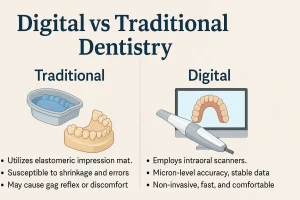
| Methodology | Uses elastomeric impression materials (e.g., PVS, Polyether) to create a negative mold poured with dental stone. | Employs intraoral scanners (IOS) to capture detailed 3D anatomy, generating STL/PLY files for CAD software. |
| Accuracy & Precision | Prone to shrinkage, deformation, and human error. | Offers micron-level accuracy and volumetric fidelity without material distortion. |
| Patient Experience | Discomfort due to impression material bulk, taste, and gag reflex. | Comfortable, fast, and non-invasive. Ideal for anxious or geriatric patients. |
| Data Management | Requires large physical storage and manual transportation. | Digital impressions can be stored, encrypted, and shared via cloud systems. |
| Clinical Insight | Meta-analyses show digital impressions yield better marginal adaptation and internal fit for crowns and bridges. |
Diagnosis and Treatment Planning (Implantology Focus)
| Feature | Analog Workflow | Digital Workflow |
|---|---|---|
| Diagnostic Tools | 2D X-rays, physical study casts, manual wax-ups. | CBCT scans, digital smile design (DSD), and virtual implant planning software. |
| Implant Planning | Based on 2D estimation; higher risk of anatomical error. | Combines CBCT + IOS data to create a 3D virtual patient, ensuring prosthetically driven implant positioning. |
| Surgical Execution | Freehand with higher invasiveness and recovery time. | Guided by 3D-printed surgical templates, enabling minimally invasive flapless implant surgery. |
| Patient Communication | Limited to verbal and static photo explanations. | Digital mock-ups and virtual smile previews enhance case acceptance and patient trust. |
Prosthesis Design and Manufacturing (CAD/CAM)
| Feature | Traditional Prosthodontics | Digital Prosthodontics |
|---|---|---|
| Design Phase | Manual waxing by technicians. | CAD software with biogeneric libraries ensures ideal occlusion and esthetics. |
| Fabrication | Lost-wax casting, pressing, or layering. | CAM milling (Zirconia, Lithium Disilicate) or 3D printing for dentures, surgical guides, and models. |
| Material Quality | Variable, with risk of porosity. | Industrial-grade materials with consistent mechanical and optical properties. |
| Reproducibility | Requires full re-impression for remakes. | Digital archive enables instant remanufacturing with identical precision. |
| Time Efficiency | Multi-visit, multi-week workflow. | Enables Same-Day Dentistry and faster turnaround time. |
Economic and Logistical Considerations
| Aspect | Analog Dentistry | Digital Dentistry |
|---|---|---|
| Initial Investment | Low; basic instruments and materials. | High; includes CBCT, CAD/CAM, 3D printer, and IOS system. |
| Patient Cost | Lower upfront. | Slightly higher but better long-term value and durability. |
| Learning Curve | Moderate; manual training. | Requires digital literacy and software skills. |
| Lab Dependency | High; all steps technician-dependent. | Clinician-driven design; labs handle automated fabrication. |
| Sustainability | Generates plaster and material waste. | Eco-friendly and paperless; supports green dentistry initiatives. |
Conclusion
The transition from analog to digital prosthodontics marks a paradigm shift toward precision, efficiency, and patient-centered care. While traditional methods retain value for basic cases, digital workflows deliver superior accuracy, comfort, predictability, and reproducibility. As technology becomes more affordable, fully digital prosthodontics will define the standard of care. Mastery of digital implant planning, CAD/CAM design, and 3D printing will be indispensable for the next generation of dental professionals.