In today’s fast evolving world of prosthodontics and restorative dentistry, Dental Lab Scanners have become an indispensable part of any modern dental laboratory or clinic. These advanced devices convert traditional plaster models or impressions into precise digital 3D files, significantly enhancing the workflow, accuracy, and efficiency of dental restorations.
In this guide, we’ll dive deep into what makes lab scanners crucial, explore their core features, highlight the main benefits, and share smart tips to help you choose the right scanner for your lab or practice. Whether you are a dental technician, prosthodontist, or lab owner — this article is your roadmap to mastering digital dental solutions with confidence.
Why Dental Lab Scanners Matter in Modern Dentistry
Dental lab scanners have become a core technology in modern dental laboratories, transforming the way restorations are designed and manufactured. By converting physical models into highly accurate digital files, these scanners help dental professionals achieve greater precision, reduce manual errors, and significantly speed up the production process. As dentistry continues to move toward fully digital workflows, dental lab scanners play a crucial role in improving efficiency, consistency, and overall treatment quality.
- Bridging Traditional and Digital Dentistry: With a dental lab scanner, you eliminate the need for messy plaster models and manual steps, creating a seamless transition from analog to digital workflows.
- Meeting High Demand with Quality: As demand for crowns, bridges, implants, and zirconia restorations increases, labs need faster turnaround times without sacrificing precision. Dental lab scanners make this possible by offering fast, highly accurate digital captures.
- Compatibility with CAD/CAM and 3D Manufacturing: Once a model is digitized, it can be used in CAD/CAM software or 3D printing/milling — enabling a fully digital workflow from scan to final prosthesis.
What Exactly Is a Dental Lab Scanner?
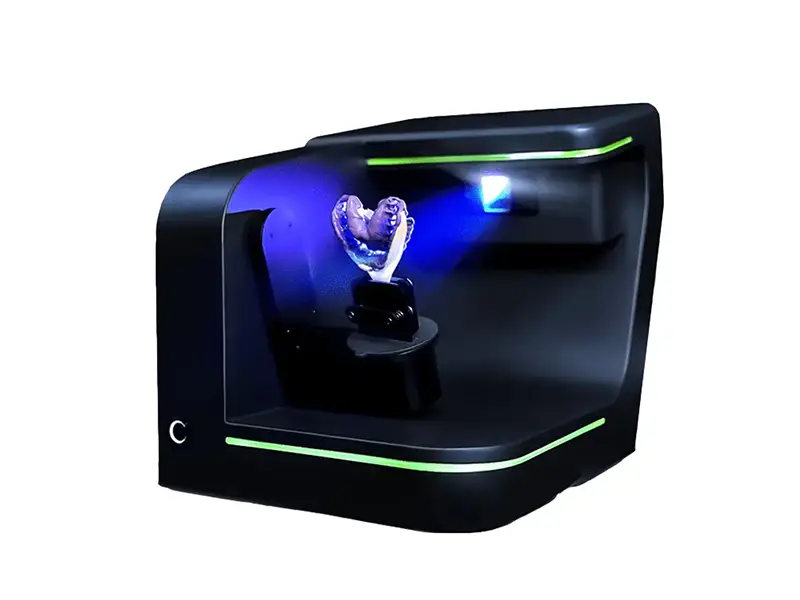
A Dental Lab Scanner is an advanced 3D imaging device specifically engineered to capture the exact shape, contours, and fine details of dental models, impressions, and stone casts with extremely high precision. Unlike traditional manual measuring techniques, this technology uses structured light or laser scanning systems to produce highly accurate digital replicas of physical dental structures.
The scanner converts these physical models into detailed 3D digital files, most commonly in formats such as STL, OBJ, or PLY. These files can then be imported into specialized CAD (Computer-Aided Design) software, where dental technicians can digitally design crowns, bridges, veneers, inlays, onlays, and implant-supported restorations with exceptional accuracy.
Beyond design, these digital files can be sent directly to CAM systems, milling machines Such as Milling Machine Lodden Heymill-W12, or 3D printers, enabling automated manufacturing of dental restorations. This digital workflow significantly reduces human error, shortens production time, and improves the overall fit and aesthetics of the final prosthesis.
In modern dental laboratories, dental lab scanners form the foundation of a fully digital workflow, connecting traditional impressions and models to cutting-edge digital design and manufacturing technologies.
Core Features to Look For in a Dental Lab Scanner
When evaluating and comparing scanners, focus on these critical features — they make the difference between a mediocre device and one that elevates your lab’s performance.
1. High-precision scanner device
Precise scanners capture details down to the micron level, ensuring that crowns, bridges, implant abutments or dentures fit perfectly.
2. Multi-axis or multi-angle scanner movement
Scanners with rotating platforms ensure that all surfaces – occlusal, proximal, margins – are captured without blind spots, which is crucial for complex restorations.
3. High-quality sensor and controlled illumination of the laboratory scanner
A quality optical system ensures that the scan data is clean and free of noise or artifacts, especially in cases involving implant analogs or fine margins.
4. Fast scanning speed and workflow efficiency of the dental scanner
Some laboratory scanners can digitize a plaster model in less than a minute – which drastically reduces fabrication time compared to traditional methods. 5. Compatibility with CAD/CAM software and common file formats
5. High-precision scanner device
Universal file formats such as STL, OBJ and PLY ensure seamless integration with dental CAD systems, milling machines and 3D printers.
6. Multi-template or batch scanning capability of dental scanners
Laboratories dealing with large volumes of data benefit from the ability to scan multiple templates simultaneously, which improves productivity and reduces labor costs.
7. After-sales support and training of dental laboratory scanners
Maintenance services, updates and calibrations ensure the long-term performance of the scanner and return on investment.
Major Benefits of Using Dental Lab Scanners
Consistency, Predictability, and Reproducibility
Digital files can be stored indefinitely, enabling easy reproduction of restorations or adjustments without repeating the entire workflow.
Improved Collaboration
Digital scans can be shared instantly between clinics and labs, enhancing communication and reducing potential errors.
Common Use Cases for Dental Lab Scanners
- Crowns & Bridges (ceramic, zirconia, PFZ)
- Implant prosthetics & custom abutments
- Removable dentures
- Orthodontic models & study casts
- Full-arch and multi-unit restorations
How to buy the right dental laboratory scanner?
Use this checklist before purchasing:
- Define your workflow and expected volume
- Prioritize accuracy and sensor quality
- Ensure compatibility with CAD/CAM and file formats
- Consider scan speed and multi-die support
- Evaluate after-sales service and warranties
- Calculate long-term operational cost, not just purchase price
- Choose a system that can evolve with future technologies
Why Investing in a Dental Lab Scanner Is a Game Changer
The shift toward digital dentistry is a fundamental transformation. Dental Lab Scanners are at its core, enabling unprecedented accuracy, faster production, and consistent outcomes. Labs aiming for growth, efficiency, and competitive advantage can no longer rely solely on analog methods — digital scanning is the new standard.
Buy Dental Lab Scanners from futuremirates
Futuremirates is a trusted supplier of dental equipment, especially dental scanners in Dubai, offering a wide range of high-precision 3D scanners compatible with leading CAD/CAM systems. Whether you are upgrading your current operations or setting up a digital workflow, our team offers advice, competitive pricing and dedicated after-sales support.
FAQs about buying dental lab scanners from futuremirates
1. Are digital scans as accurate as plaster models?
Yes. Modern dental lab scanners offer equal or better accuracy with less distortion.
2. Is it worth the investment?
Absolutely. For labs with medium to high workloads, the reduction in restorations and faster throughput justify the investment.
3. Can digital workflows replace traditional techniques?
In many cases, yes – especially for fixed restorations and implants.
4. What about the software?
Choose software that is compatible with margin marking, occlusion adjustment, articulation, and multi-unit restorations.
5. Does scanning improve turnaround time?
Yes – designs can begin immediately after scanning, dramatically reducing production time.