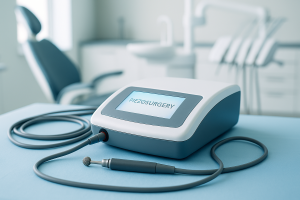
piezosurgery in dentistry: A piezosurgery machine (ultrasonic bone surgery unit) with its handpiece and irrigation system visible. Piezosurgery – also known as ultrasonic bone surgery or piezoelectric bone surgery – is a revolutionary technique that allows dentists to cut hard bone tissue using ultrasonic vibrations, rather than traditional drills or saws. This innovation enables precise bone cutting while protecting soft tissues like gums, nerves, and blood vessels from accidental damage. For dental surgeons, piezosurgery opens up new possibilities to perform procedures with greater accuracy, safety, and patient comfort, making it an exciting advancement in oral surgery technology.
What is Piezosurgery and How Does It Work?
At the heart of piezosurgery is the piezoelectric effect – when certain crystals (e.g. quartz) receive an electric current,
they vibrate at very high ultrasonic frequencies. A piezosurgery device harnesses this effect: the machine’s handpiece contains
piezoelectric crystals that convert electrical energy into rapid micro-vibrations. The ultrasonic vibration (typically >25 kHz)
is transmitted to a specialized cutting tip on the handpiece. Remarkably, these vibrations are selective to hard tissue: they cut mineralized bone
but do not cut elastic soft tissues. In other words, the bone is precisely ablated while adjacent soft tissue (like the membrane of a sinus or a nerve bundle)
merely “vibrates” with the frequency and remains unharmed. This selective cutting action is what makes piezosurgery uniquely gentle and atraumatic compared to conventional surgical tools.
Close-up of a piezoelectric surgical handpiece tip, which vibrates at ultrasonic frequency to cut bone without harming nearby soft tissue.
When the surgeon activates the foot pedal, the piezoelectric tip oscillates in micrometric movements – on the order of a few microns – allowing
extreme precision in cutting. A cavitational cooling irrigation typically accompanies the vibrations, flushing the site with sterile
fluid to prevent heat build-up and to keep the surgical field clear of blood (the ultrasonic cavitation effect helps coagulate small vessels,
leading to a nearly blood-free field). The result is a highly controlled osteotomy (bone cut) with minimal thermal damage and excellent visibility.
In essence, a piezosurgery machine (often called a dental piezo unit) empowers the dentist to perform bone operations that were once difficult or risky, with confidence that soft tissues are safeguarded.
Applications of Piezosurgery in Dentistry
Piezosurgery has rapidly found a home in many dental and oral surgery procedures that demand finesse and tissue preservation. Key applications include:
-
Dental Implant Surgery & Bone Grafting: Ultrasonic bone surgery is widely used for preparing implant osteotomy sites, sinus lift procedures, ridge splitting, and harvesting bone grafts. The precise cuts allow implant placement with minimal risk of perforating the sinus membrane or injuring nerves in the jaw.
-
Tooth Extractions (Wisdom Teeth and Others): For difficult extractions, such as impacted third molars or ankylosed teeth, piezo devices can gently remove surrounding bone or section a tooth with less trauma. This leads to easier extraction and preservation of bone structure for healing or future implant placement.
-
Periodontal Surgery: In periodontics, piezosurgery facilitates delicate osseous surgery like crown lengthening, root tip resection (apicoectomy), and bone contouring (osteoplasty) around teeth. The selective cutting protects roots and soft tissues while precisely removing or reshaping bone, improving outcomes in regenerative procedures.
-
Endodontic and Oral Surgery: Piezosurgical units can aid in root canal surgeries (creating access or retrograde preparation) and minor oral surgeries like cyst removals or exposing impacted canines, where control is paramount near vital structures.
Dentists have embraced piezo technology for these scenarios because it enables procedures that were previously more invasive or risky. Notably, piezosurgery isn’t confined to dentistry – it has also been adopted in other medical fields. Oral & maxillofacial surgeons, orthopedic surgeons, and ENT specialists use piezoelectric bone surgery for procedures near delicate areas (such as spinal surgeries near the spinal cord, or ear surgeries on the tiny ossicles). This cross-disciplinary use underscores the trust in piezosurgery’s safety and precision when working around critical anatomical structures.
Advantages and Disadvantages of Piezosurgery
As with any technology, it’s important to weigh the benefits and drawbacks of piezosurgery. Fortunately, the advantages for dental practice are significant:
Advantages of Piezosurgery
-
Selective Hard-Tissue Cutting (Soft Tissue Safety): Piezosurgery’s biggest advantage is its ability to cut bone without damaging soft tissue. Sensitive structures like the gums, nerves, or sinus lining are protected, drastically reducing the risk of complications. This makes procedures like lateral sinus lifts much safer (studies report over 80% reduced risk of sinus membrane perforation using piezo vs. conventional tools).
-
Exceptional Precision and Control: The micro-vibrations allow micrometric cuts with minimal effort. Surgeons can make very fine osteotomies, preserving more bone and avoiding excessive loss. This level of control is crucial for delicate tasks like harvesting thin bone plates or navigating around tooth roots.
-
Reduced Trauma & Better Healing: Because it spares soft tissue and causes less bone micro-fracturing, piezo cutting leads to less postoperative pain and swelling for patients. Clinical studies confirm that patients experience significantly less edema, trismus, and pain compared to traditional rotary instruments. Cleaner cuts also promote faster osseous healing and earlier bone regeneration.
-
Minimal Bleeding: The ultrasonic frequency has a coagulative effect on small blood vessels. Bleeding during surgery is reduced, resulting in a clearer field and often shorter procedure time since the surgeon isn’t constantly managing hemostasis.
-
Thermal Safety: Unlike high-speed drills, which can overheat bone and risk thermal necrosis, piezosurgery generates less heat. Coupled with continuous irrigation, this means bone cells are preserved and the vitality of the cut bone is higher. Vital bone and cell survival in piezo-harvested grafts have been shown to be superior to those harvested with burs.
In sum, piezosurgery offers a combination of safety, precision, and gentleness that is hard to match with conventional instruments. As one publication noted, it is “an excellent tool to handle delicate or compromised hard- and soft-tissue conditions with less risk for the patient”. These advantages have made it a go-to choice for many implant and periodontal specialists seeking better patient outcomes.
Disadvantages of Piezosurgery
-
Slower Cutting Speed: A known downside is that piezosurgery is not as fast at cutting bone as traditional burs or saws. The precision comes at the cost of speed – in some cases osteotomies can take 3–4 times longer than with conventional drills. For extensive bone removal, this extended time can be a consideration. However, many clinicians find the trade-off acceptable given the improved safety and healing.
-
Higher Equipment Cost: Piezosurgery units and their specialized tips represent a significant investment. A piezo machine (handpiece, console, foot pedal) can cost several times more than a basic surgical drill, and the tips – which must be replaced periodically – are also more expensive than standard burs. This upfront cost may be a barrier for some practices initially.
-
Learning Curve and Technique Sensitivity: Using a piezosurgery device requires training and practice. The tactile feedback is different from a drill – the surgeon must use light pressure and let the micro-vibrations do the work. Beginners might find the instrument cuts slowly if not used correctly. Proper technique (and selecting the right tip and settings for each task) comes with experience, so there is a specialized training requirement. Many manufacturers offer training courses to help new users get up to speed.
-
Tip Limitations: The piezo tips come in various shapes (saws, scalpel-like blades, etc.), but each is designed for specific types of cuts. They are effective for fine and medium cuts; however, for very dense cortical bone or for bulk bone removal, multiple passes or different tips might be needed. In some cases, surgeons might still resort to a bur for fastest results, using piezo for the most critical portions near soft tissue.
Despite these disadvantages, piezosurgery has firmly established itself as a complementary tool rather than a complete replacement for traditional instruments. In delicate surgeries where safety is paramount, most clinicians agree that the benefits far outweigh the slower speed or cost. As ultrasonic technology continues to improve, newer piezo units are already cutting faster and more efficiently than earlier models, narrowing the gap in performance.
How to Choose the Best Piezosurgery Unit
If you’re a dentist convinced of piezosurgery’s value, the next step is selecting the right device for your practice. Not all piezo systems are the same – they vary in power, features, and ergonomics. Here are important considerations when choosing the best piezosurgery machine:
-
Adjustable Power and Frequency: Look for a unit with multiple power settings and modulation modes. Being able to dial up or down the ultrasonic power (and frequency) is crucial because dense cortical bone may require higher power, whereas delicate osteotomies near the sinus might need fine control. Advanced units even have specific modes (e.g. “Bone”, “Endo”, “Perio” modes) with preset power/frequency ranges for different tasks. This versatility lets you optimize cutting efficiency without sacrificing safety.
-
Variety of Tips: A good piezosurgery unit should come with (or support) a comprehensive set of tips for various surgical applications. This typically includes bone saw tips of different sizes, sharp spatula-like tips for cutting, rounded tips for sinus membrane elevation, periotomes for extractions, etc. Check that the manufacturer offers the specific tips you’ll need (implant site prep, sinus lift, periodontal surgery, etc.). The availability and cost of replacement tips is also a factor for long-term use.
-
Effective Cooling/Irrigation System: Overheating protection is vital. Ensure the unit has an efficient irrigation system – usually a peristaltic pump that delivers sterile saline to the tip constantly. This cools the tip and flushes debris. Some machines allow adjustable flow rate of coolant. A good unit will maintain a safe tip temperature and prevent bone heat damage even during lengthy cuts. (Tip: devices with feedback control can modulate power if they detect too much resistance/heat buildup.)
-
Ergonomics and Build Quality: Pay attention to the handpiece design and overall build. The handpiece should be lightweight, well-balanced, and comfortable to reduce hand fatigue during long surgeries. Does it have an integrated LED light for better visibility? Are the cord and connectors robust? The console interface should be user-friendly (touchscreen controls are common on high-end models). Also consider the size of the unit – a compact footprint can save space if your operatory is tight. Durable, medical-grade construction will ensure longevity and reliable performance (especially important given the investment).
-
Brand Reputation and Support: Choose a reputable brand with a proven track record in ultrasonic technology. Established manufacturers (e.g. Mectron, ACTEON, W&H, etc.) not only deliver quality equipment but also typically provide better customer support, training, and warranty service. Strong after-sales support means you can easily find replacement parts and get repairs or technical help if needed. Also consider the warranty period and whether the supplier offers local servicing. A piezosurgery unit is a long-term investment, so you want the backing of a company that will be around to support you.
Finally, always evaluate your practice’s specific needs. For instance, if you plan to use the piezo mainly for implant surgery, prioritize a unit that excels in bone cutting speed and has the necessary implant prep tips. If you will also use it for perio or endo microsurgery, ensure the device has modes and tips for those finer applications. It’s wise to demo a unit if possible or consult colleagues who use one. Given the cost, some dentists start with an entry-level piezo device, then upgrade later as they grow comfortable with the technology.
(Internal Tip: Futuremirates offers a selection of advanced piezosurgery units from leading brands. You can browse our catalog or contact our team for personalized advice on choosing the ideal ultrasonic bone surgery equipment for your clinic.)
Conclusion: Embracing Ultrasonic Bone Surgery
Piezosurgery has undeniably become a game-changer in modern dental surgery, allowing clinicians to perform invasive bone procedures with a new level of confidence and safety. By harnessing ultrasonic vibrations, dentists can achieve outcomes that were once considered highly challenging – from atraumatic extractions to precise implant site preparations – all while keeping vital tissues intact. This technology exemplifies the drive toward minimally invasive dentistry, where patient trauma is reduced and natural anatomy is preserved whenever possible.
While piezo units will not entirely replace the dental drill (for routine work and speedy cutting of large volumes of bone, traditional tools still have their place), they have become an indispensable adjunct for specific scenarios. Many forward-thinking dental clinics now incorporate piezosurgery as part of their standard surgical armamentarium, especially for implantology and periodontal therapy. The scientific literature continues to expand in support of its benefits, with reports of improved healing and reduced complication rates.
In summary, piezosurgery offers a compelling blend of precision and safety that elevates the standard of care in oral surgery. For dentists aiming to provide the best for their patients – whether it’s less post-op pain, faster recovery, or simply the peace of mind knowing that nerves and gums are protected – investing in an ultrasonic bone surgery unit is well worth the consideration. The future of oral surgery is here, and it sounds like a gentle hum of ultrasonic vibrations cutting with laser-like accuracy. Embracing this innovative technology can set your practice apart, delivering better outcomes and positioning you at the forefront of dental medicine.
╗ Ready to explore piezosurgery for your practice? Visit our Futuremirates product pages to learn more about available piezo units, or reach out to us for a demo. Equip yourself with the tools of tomorrow and experience the difference in precision and patient satisfaction. Your patients (and their bones) will thank you!