Modern dental CAD/CAM milling systems are the foundation of today’s digital dentistry revolution. They transform 3D digital designs into accurate physical restorations — crowns, bridges, and implant abutments — with exceptional precision.
Understanding the core components of these systems is vital for labs seeking to improve efficiency and maintain quality. This article explores the five powerful components shaping the performance of advanced CAD/CAM milling systems: the spindle motor, automatic tool changer (ATC), multi-axis motion system, intelligent control software, and material compatibility.
High-Speed Spindle Motors – The Heart of Milling Power
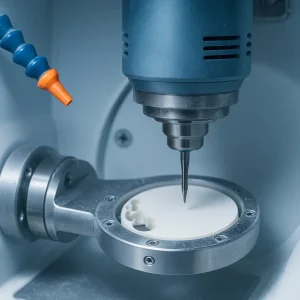
The spindle motor is the most critical component of any milling machine. In dental CAD/CAM milling systems, it rotates the cutting bur up to 60,000 RPM, shaping zirconia, PMMA, and titanium with microscopic precision.
Manufacturers like Roland DG and imes-icore offer spindles with liquid cooling and brushless motors, ensuring both torque and stability. A high-quality spindle reduces vibration, extends bur life, and guarantees superior surface finish.
Automatic Tool Changer (ATC) – Efficiency Without Manual Intervention
An Automatic Tool Changer (ATC) allows continuous, unattended milling. It automatically selects the right tool for each stage, improving speed and accuracy.
Premium systems like CORiTEC 350i PRO feature 20-tool ATCs with automatic wear detection and sister-tool replacement — ensuring nonstop production even during long, complex jobs.
💡 Internal Tip: Read more about our dental milling machines collection to compare ATC capacities and automation levels.
Multi-Axis Motion Systems – 5-Axis Precision Engineering
Modern 5-axis dental CAD/CAM milling systems outperform traditional 3-axis models by enabling full rotational freedom of the blank. This capability allows intricate geometries — such as screw-retained implant bridges — to be milled in a single setup.
Systems like vhf’s Z4 and R5 provide robust motion mechanics with servo motors and temperature-compensated ball screws for sub-micron accuracy. The result? Faster production cycles and improved marginal fits.
Intelligent Control Software – The Brain of the Machine
Control software integrates the entire CAD/CAM workflow. Open-architecture controllers (like those from HyperDENT or Sum3D) allow labs to import STL, 3Shape, or Exocad files directly.
These smart systems automatically generate optimized toolpaths and adjust cutting parameters per material. At FutureMirates, we focus on providing open, intuitive platforms compatible with major dental design ecosystems.
Material Compatibility – From Zirconia to Titanium
The best dental CAD/CAM milling systems handle a full range of materials: zirconia, PMMA, wax, PEEK, lithium disilicate, and titanium.
-
Dry Milling: Perfect for zirconia and acrylics — fast and clean.
-
Wet Milling: Required for ceramics and metals — coolant protects both tool and surface.
-
Hybrid Systems: Machines like Roland DWX-53DC can automatically switch between wet and dry, increasing flexibility.
For deeper technical specifications, refer to 3Shape’s official material guide (external resource).
Why Dental CAD/CAM Milling Systems Matter
Unlike manual fabrication, digital CAD/CAM milling systems provide repeatable precision, improved turnaround, and scalable production. Combined with high-speed spindles and 5-axis freedom, these machines redefine efficiency in dental labs worldwide.
To explore compatible accessories and maintenance tools, check our Dental Lab Equipment section.
Conclusion
Choosing the right dental CAD/CAM milling system means investing in reliability, speed, and future-proof integration. Understanding these five powerful components helps dental professionals maximize precision and productivity.
At FutureMirates, we’re committed to helping clinics and labs adopt the latest digital manufacturing technologies — connecting innovation with craftsmanship for the future of precision dentistry.