Introduction
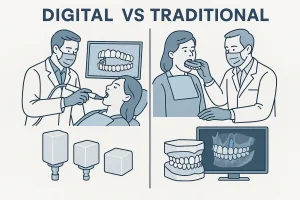
For decades, prosthodontics relied on precise craftsmanship—elastomeric impressions, wax-ups, and manual casting. In today’s clinics, the debate of digital vs traditional dentistry defines how professionals deliver accuracy, comfort, and speed. Digital systems have evolved into a complete ecosystem—from intraoral scanning and CAD/CAM milling to 3D printing and guided surgery. This article compares digital vs traditional dentistry step by step and helps you understand when to go digital and when analog still makes sense.
1. Data Acquisition & Impression Accuracy
Traditional Dentistry
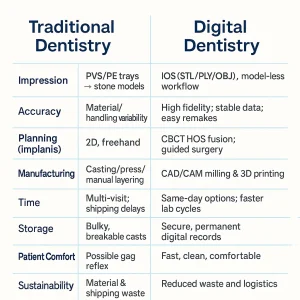
Conventional impressions use polyvinyl siloxane (PVS) or polyether in trays, followed by stone casting. Each step invites distortion: shrinkage, tray flex, and bubbles. Physical casts are heavy, fragile, and need long-term storage. Patients often experience gag reflex and discomfort.
Digital Dentistry
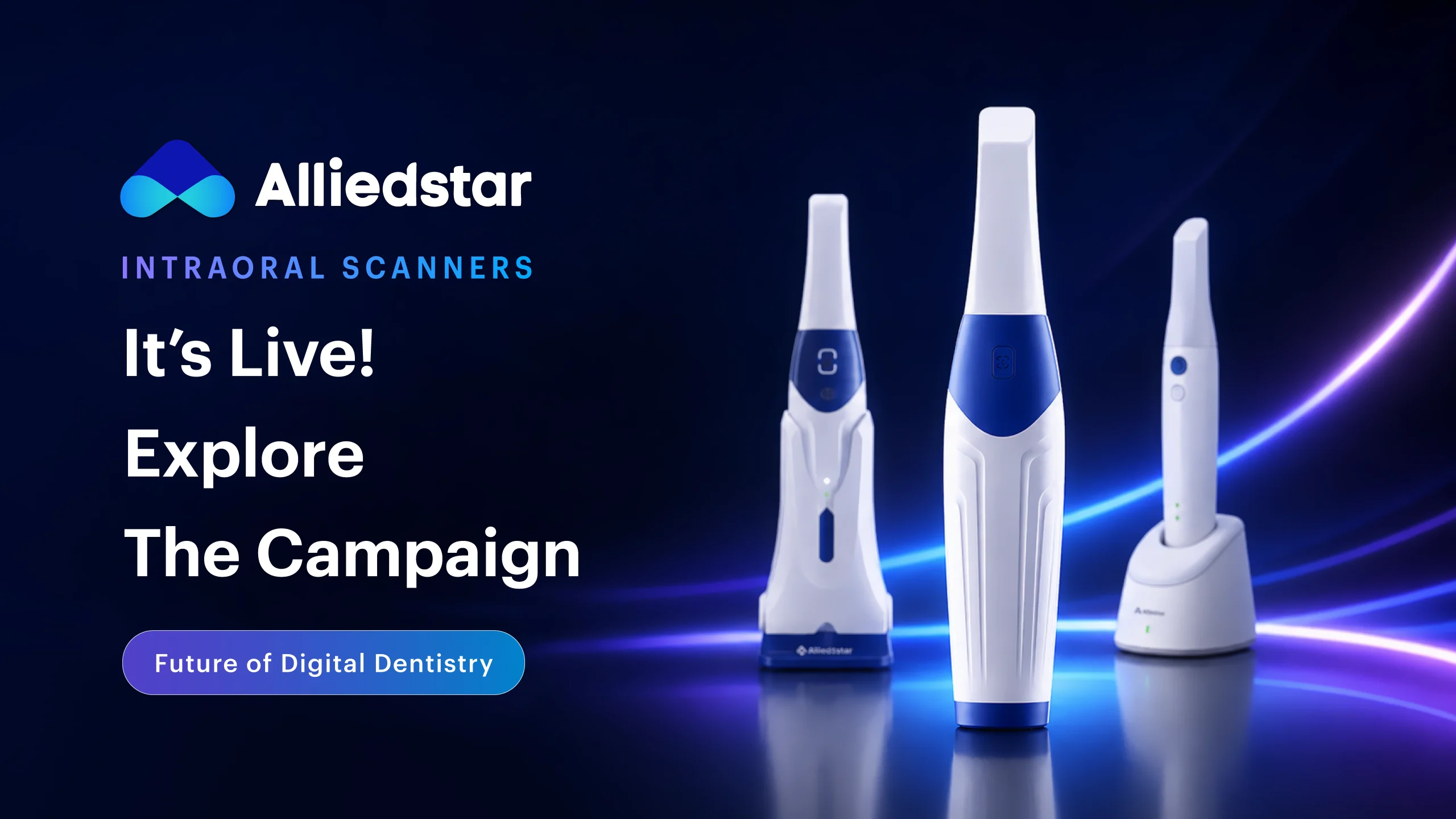
Intraoral scanners capture millions of 3D data points per second, creating accurate STL or PLY files. These files transfer instantly to the lab or to a chairside CAD/CAM system—no shipping, no plaster. The difference between digital vs traditional dentistry starts here: digital impressions reduce human error, speed up workflow, and enhance patient experience.
Intraoral Scanners at FutureMirates • 3Shape Official Site • iTero Element Scanner
2. Diagnosis & Treatment Planning
Traditional
2D radiographs and stone models limit diagnostic accuracy. Implant placement is usually freehand—less predictable and more invasive.
Digital
By merging CBCT scans with intraoral data, clinicians create a “virtual patient.” Implant planning becomes prosthetically driven—defining the ideal position, angulation, and depth before surgery. 3D-printed guides enable flapless, minimally invasive procedures with faster recovery. In this phase, digital vs traditional dentistry shows dramatic clinical improvement in safety and predictability.
3. Prosthesis Design & Manufacturing (CAD/CAM)
Traditional
Wax-ups, metal casting, and ceramic layering depend heavily on technician skill. Remakes mean starting over with a new impression, increasing time and cost.
Digital
CAD software standardizes emergence profiles and connector designs. CAM mills crowns and bridges from industrial-grade materials like zirconia, lithium disilicate, and titanium. 3D printing adds new capabilities—custom trays, models, and even final dentures with certified biocompatible resins. In the world of digital vs traditional dentistry, digital manufacturing guarantees repeatability, strength, and precision.
CAD/CAM & 3D Printing Solutions • Formlabs Dental 3D Printers
4. Economics, Logistics & Sustainability
Traditional Dentistry
Lower startup cost but higher recurring expenses—impression materials, stone, courier costs, and remakes. Physical waste increases environmental impact.
Digital Dentistry
Although scanners and milling units require initial investment, digital workflows minimize long-term costs. Reduced chair time, fewer remakes, and eco-friendly paperless storage improve sustainability. Clinics adopting digital vs traditional dentistry models report higher efficiency and ROI.
5. Clinical Outcomes & Patient Experience
In every measurable parameter, digital vs traditional dentistry favors the digital approach:
- Precision: Smaller marginal gaps reduce secondary caries.
- Speed: Same-day restorations are possible.
- Comfort: No messy impression trays or gag reflex.
- Documentation: Every scan, CAD file, and CAM log is traceable for QA and medico-legal clarity.
6. Implementation Roadmap for Clinics
- Begin with intraoral scanning for single-unit restorations.
- Partner with a digital-ready laboratory.
- Integrate CBCT and guided implant planning.
- Adopt chairside CAD/CAM for same-day crowns.
- Add 3D printing for models and dentures.
- Train your team for scanning and software workflows.
- Track KPIs: remake rate, chair time, satisfaction, and cost savings.
7. When Traditional Still Matters
Despite digital growth, some cases still favor analog techniques:
- Deep subgingival margins or bleeding sites unscannable by IOS
- Downtime backups when digital systems fail
- Unique removable prostheses crafted by experienced technicians
- Clinics in resource-limited settings
In short, digital vs traditional dentistry is not competition—it’s collaboration. Both coexist to achieve optimal results.
Conclusion
The rise of digital vs traditional dentistry marks a turning point in modern prosthodontics. Digital workflows amplify human expertise with data-driven precision, improving every aspect—from accuracy to sustainability. Clinics that embrace digital systems deliver restorations faster, stronger, and more aesthetic, while maintaining full traceability. Traditional methods retain value, but the standard of care is now digital.