Sterilization Workflow in Dentistry: Dentistry demands a rigorous approach to infection control. A modern sterilization workflow goes beyond simply placing instruments in an autoclave—it is a continuous chain of safety that starts when a procedure ends and finishes when instruments are stored for the next patient. Adopting this workflow demonstrates a commitment to patient protection, regulatory compliance and professional integrity.
Why the Workflow Matters
Instruments used during dental procedures come into contact with blood and saliva. If contaminants remain on tools or if instruments are transported or stored improperly, microorganisms can spread and threaten patient and staff safety. Regulatory bodies emphasise that instruments must be cleaned thoroughly, packaged correctly, sterilized using validated cycles and stored under controlled conditions. A disciplined workflow reduces sharps injuries, prevents cross‑contamination and ensures that dental clinics meet the highest standards of care.
Step 1: Collection and Safe Transport
After a procedure, instruments are potentially infectious. Modern method: instruments are immediately placed into covered, puncture‑resistant containers for transport. These closed containers prevent exposure to sharps and contain any liquids, reducing the risk of injury or contamination. Traditional method: instruments were commonly carried on open trays or by hand, exposing staff to sharps injuries and allowing contaminants to spread.
Best practices
-
Designate a secure hand‑off area where contaminated instruments can be placed immediately.
-
Use containers that are leak‑proof, puncture‑resistant and labelled as “biohazard.”
-
Train all staff on handling protocols to prevent accidental exposure.
Step 2: Pre‑Cleaning and Disinfection
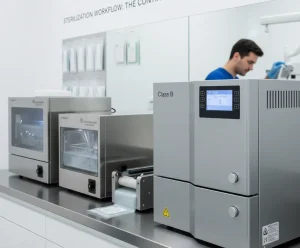
Organic debris (bioburden) protects microorganisms from heat or chemicals. Cleaning must precede sterilization: Ultrasonic cleaners use high‑frequency sound waves to generate cavitation bubbles that scrub surfaces and dislodge debris from crevices. Scientific guidance notes that ultrasonic cleaning does not inactivate microbes but is highly effective when combined with detergents. Automated washer‑disinfectors further reduce manual handling by combining washing and thermal disinfection.
Manual scrubbing can still be used for items unsuitable for ultrasonic cleaning, but workers should wear heavy‑duty gloves and use long‑handled brushes. Automated systems lower injury risk and standardize the process.
Modern workflow vs traditional methods
| Aspect | Modern approach | Traditional approach |
|---|---|---|
| Cleaning method | Ultrasonic cleaner and washer‑disinfector remove soil via cavitation and standardized cycles; automated systems minimize staff contact and variability | Manual scrubbing with brushes; less effective on instruments with complex geometry and increases injury risk |
| Solution management | Fresh cleaning solution for each cycle; detergents designed for ultrasonic use | Reuse of cleaning solutions; risk of microbial contamination and decreased effectiveness |
| Monitoring | Regular maintenance and validation of ultrasonic units, including cavitation tests | Often no monitoring beyond visual inspection |
Step 3: Packaging Instruments
Sterilization packaging must allow steam penetration and maintain sterility until use. Self‑sealing sterilization pouches combine medical‑grade paper and transparent film with an adhesive closure. These pouches contain built‑in chemical indicators that change colour when processed, providing confirmation to staff Heat‑sealed pouches are made from rolls of paper/film and require a sealing machine; they produce a robust, customized pouch ideal for high‑volume practices. For larger or irregular instruments, gusseted pouches or rigid containers may be appropriate.
Traditional methods sometimes relied on cloth wraps or leaving instruments loose on trays, which allowed re‑contamination. Modern packaging protects instruments during transit from the sterilizer to the patient and provides tamper evidence.
Packaging tips
-
Dry instruments thoroughly: Wet instruments compromise packaging integrity and can cause corrosion.
-
Do not overload: Place instruments loosely inside the pouch to ensure steam reaches all surfaces.
-
Label and date: Use markers and include load identifiers; avoid stickers that can puncture packaging.
Step 4: Sterilization
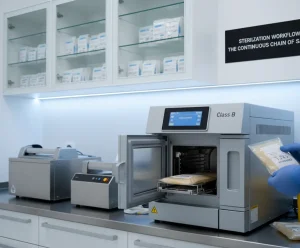
Steam sterilization (autoclaving) remains the gold standard for dental instruments. Class B autoclaves use a vacuum pump to evacuate air from the chamber, ensuring steam penetrates wrapped and hollow instruments completely, while Class N autoclaves rely on gravity displacement and may leave air pockets. For packaged instruments or devices with lumens, a Class B autoclave is recommended.
Sterilization cycle parameters
Research shows that steam must be at the correct temperature and exposure time to achieve microbial kill. Authoritative guidance lists the following cycles:
-
Pre‑vacuum (Class B): Minimum exposure of 4 minutes at 132 °C. Typical modern cycles run at 132–135 °C for 3–4 minutes.
-
Gravity displacement (Class N): Minimum exposure of 30 minutes at 121 °C.
-
International standards recommend that porous loads achieve a lethality equivalent to 3 minutes at 134 °C or 15 minutes at 121 °C.
Clinicians should select a cycle appropriate for the load and follow the manufacturer’s instructions for the specific autoclave. Bowie‑Dick tests and chemical indicators verify that air removal and steam penetration are adequate before running daily loads.
Benefits of modern sterilizers
-
Improved turnaround: High‑temperature cycles (134 °C) sterilize instruments quickly—approximately 3–4 minutes—allowing faster instrument rotation.
-
Vacuum efficiency: Vacuum pumps ensure complete steam penetration for hollow instruments such as dental handpieces.
-
Documentation: Digital autoclaves record temperature and pressure data for regulatory compliance.
Step 5: Storage of Sterile Instruments Sterilization Workflow in Dentistry
The sterilization process is only effective if sterility is maintained during storage and handling. Modern practices store sterilized packages in closed, dry cabinets. Public health authorities note that shelf life is event‑related: a sterile package remains sterile until it is opened, wet, torn or otherwise compromised. In other words, there is no arbitrary expiry date; rather, the package must be inspected and reprocessed if integrity is lost.
Storage areas should meet environmental conditions: they should be adjacent to the sterilization area, temperature and humidity controlled, moisture‑resistant, dust‑free and protected from direct sunlight. Items should be placed on solid shelves at least 20 cm above the floor and 50 cm from the ceiling to allow air circulation and cleaning. Avoid stacking heavy items on pouches, which could damage seals.
Event‑related vs date‑related systems
Traditional protocols sometimes assigned a fixed expiry date to sterile packages. However, evidence shows that packages remain sterile indefinitely if package integrity is preserved; therefore, the event‑related approach is widely adopted.
Commitment to Excellence: Beyond Compliance
A comprehensive sterilization workflow is a statement of professional commitment. Modern practices invest in high‑quality equipment, implement evidence‑based protocols and train staff continuously. When patients see instruments removed from sealed pouches and processed through modern equipment, it builds trust and demonstrates that the clinic prioritizes safety.
How Futuremirates supports your workflow
Futuremirates specialises in equipping dental clinics in the UAE with state‑of‑the‑art sterilization technology. Our consultants can help you select and validate Class B autoclaves, ultrasonic cleaners, automated washer‑disinfectors, and packaging systems suited to your clinic’s volume and instrument types. We also offer training on proper transport, cleaning, packaging and storage techniques. Visit Futuremirates sterilization solutions to explore products and receive customised support.
Internal and external resources
-
Dental Autoclave FAQs – an internal guide on choosing the right autoclave for your practice.
-
CDC Infection Control Guidelines – official recommendations for cleaning, packaging, sterilization and storage.
-
Public Health Ontario Storage Recommendations – details on event‑related shelf life and storage conditions.
Final Thoughts
Sterilization is not a single event but a workflow that safeguards patients and staff at every step. In the UAE’s competitive dental landscape, adopting modern sterilization methods demonstrates professionalism and positions your clinic at the forefront of patient safety. Futuremirates stands ready to assist you in implementing this workflow—from selecting the right equipment to training your team—so that your practice can operate with confidence and excellence.